
Key Takeaways
- IS Docs and Square 9 both help organizations digitize documents, automate workflows, and improve access to business information.
- One of the biggest differences is licensing: IS Docs offers unlimited users, while Square 9 uses user-based licensing.
- Square 9 is designed to support organizations with highly configurable enterprise content management requirements.
- IS Docs focuses on delivering the document management and workflow capabilities most organizations use every day with predictable licensing and straightforward deployment.
- Choosing the right platform depends on your organization’s goals, growth plans, and how many people will ultimately need access.

Choosing a Document Management Platform Is About More Than Features
Most modern platforms offer document storage, search, workflow automation, security, and cloud access. On paper, many solutions appear remarkably similar.
The real differences often become obvious after implementation, when organizations begin expanding the platform to additional departments, onboarding more users, or automating new business processes.
Two solutions that frequently appear on shortlists are IS Docs and Square 9. Both are established document management platforms designed to help organizations reduce paper, improve productivity, and better manage business information.
While they share many core capabilities, they take different approaches to licensing, deployment, and long-term growth.
Here’s a closer look at how they compare.
What Both Platforms Do Well
Both IS Docs and Square 9 provide capabilities that help organizations transition from paper-based processes to digital workflows, including:
- Secure electronic document storage
- Full-text search and OCR (Optical Character Recognition)
- Workflow automation
- Version control
- Audit trails
- Permission-based security
- Cloud deployment options
- Integration with business applications
For organizations looking to eliminate paper files, simplify document retrieval, and automate repetitive processes, either platform can provide meaningful improvements over traditional document storage.
The decision often comes down to how your organization plans to use the platform over time.

1. Licensing and Scalability
One of the biggest differences between IS Docs and Square 9 is how organizations license the software.
Square 9 uses a user-based licensing model, allowing organizations to purchase access based on the number of users and selected platform components. This approach works well for organizations that want to carefully control access or begin with smaller deployments.
IS Docs takes a different approach by offering unlimited users.
While that may sound like a simple pricing difference, it can significantly affect long-term adoption.
Many organizations begin with one department, such as Accounts Payable or Human Resources. As employees become familiar with the platform, other departments often want access to contracts, employee files, customer records, project documentation, or operational workflows.
With unlimited users, organizations don’t have to pause expansion to evaluate additional licensing costs each time another department wants to participate.
Instead, they can focus on finding new ways to improve document workflows across the business.
For growing organizations, that flexibility can make long-term planning much simpler.
2. Simplicity vs. Extensive Configuration
Another difference lies in each platform’s overall approach.
Square 9 offers an extensive suite of capabilities, including intelligent document capture, digital forms, advanced workflow configuration, and numerous integration options. Organizations with highly specialized requirements may appreciate the platform’s depth and flexibility.
IS Docs focuses on delivering the document management and workflow capabilities most businesses use every day without requiring unnecessary complexity.
A platform that is straightforward to deploy, easy to learn, and practical to manage often delivers value sooner than one requiring extensive configuration before users can begin working.
Neither approach is inherently better. The right choice depends on the complexity of your business processes and the level of customization your organization requires.
3. Supporting Organization-Wide Adoption
Document management projects often start small.
A company might initially implement the software to automate invoice approvals or digitize personnel records.
Once employees experience faster document retrieval and streamlined workflows, interest typically spreads.
Finance wants access.
Operations wants to digitize procedures.
Sales wants customer documentation.
Legal wants contract management.
The platform gradually becomes an organization-wide resource rather than a departmental tool.
This is where licensing can influence adoption.
When each additional user requires a separate licensing decision, organizations may limit access to a smaller group of employees.
With unlimited users, departments can be added as business needs evolve, helping organizations extend the value of their investment without having to revisit licensing each time the platform grows.

4. Total Cost of Ownership
When evaluating document management software, the purchase price is only one part of the equation.
Organizations should also consider:
- Implementation
- User adoption
- Administration
- Future expansion
- Ongoing licensing
- Long-term budgeting
A platform with predictable licensing can simplify financial planning, particularly for organizations expecting continued growth.
Unlimited-user licensing means future expansion doesn’t necessarily result in additional user licensing discussions.
At the same time, organizations with highly specialized enterprise requirements may determine that additional configuration capabilities justify a different licensing structure.
Looking beyond the initial implementation helps organizations better understand the long-term value of their investment.
5. Ease of Adoption Matters
Even the most capable document management platform only delivers value if people use it consistently.
Successful implementations depend on employees being able to quickly locate documents, understand workflows, and incorporate the system into their daily responsibilities.
Organizations often underestimate the importance of user adoption when comparing software solutions.
Simple navigation, intuitive search, and practical workflow automation can encourage broader use across multiple departments.
Likewise, removing barriers to access—such as concerns about adding new users as the organization grows—can support wider adoption over time.
The easier a platform is to introduce across the organization, the more opportunities there are to replace manual, paper-based processes with digital workflows.
Which Platform Is the Better Fit?
Every organization has different priorities, but the following comparison provides a general overview.
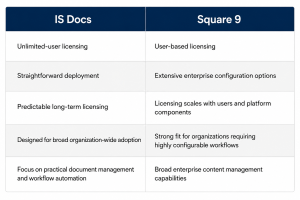
Rather than asking which platform is better, it’s more useful to ask which platform better aligns with your organization’s goals.
Questions to Ask Before Deciding
Before selecting any document management solution, consider the following questions:
- How many employees may eventually need access?
- Will multiple departments use the platform over time?
- Is predictable licensing important as the organization grows?
- How much workflow customization do we actually need?
- How quickly do we want employees to begin using the system?
- Which solution best supports our long-term business strategy?
The answers often provide more clarity than comparing feature lists alone.
FAQs
Is IS Docs a good alternative to Square 9?
Yes. Both platforms provide document management, workflow automation, OCR, and secure document storage. Organizations seeking predictable licensing and unlimited users may find IS Docs a strong alternative, while those with highly specialized enterprise requirements may prefer Square 9’s broader configuration capabilities.
Why do unlimited users matter in document management?
As document management expands beyond a single department, additional employees often need access. Unlimited-user licensing allows organizations to extend the platform across the business without purchasing additional user licenses as adoption grows.
Which industries benefit from IS Docs?
IS Docs supports organizations across healthcare, finance, education, government, legal, manufacturing, and many other industries where secure document management, workflow automation, and efficient access to information are important.
See How Unlimited Users Can Change the Way You Manage Documents
Choosing a document management platform is a long-term investment. While both IS Docs and Square 9 offer powerful tools for managing documents and automating business processes, the right solution depends on how your organization plans to grow.
If you’re looking for a platform that combines secure document management, workflow automation, and the flexibility of unlimited-user licensing, IS Docs provides a practical solution that supports organization-wide adoption without adding licensing complexity as your needs evolve.
Contact IS Docs today to schedule a personalized demonstration and discover how unlimited users can help your organization get more value from document management.
About IS Docs
IS Docs simplifies document management with AI, secure automation, nationwide support, and unlimited users, allowing businesses to streamline paper-based and digital workflows at no extra cost.